

The Egyptian foreign minister said that Egypt was calling on Israel to “maintain maximum restraint” as ceasefire negotiations between Israel and Gaza continue.
Sameh Shoukry, the country’s minister of foreign affairs, said that Israel must work to “avoid further escalation at this sensitive point in the negotiations on the ceasefire agreement”, Axios reported.
“Egypt is holding talks with all parties to find a solution that will prevent an explosion,” he said.
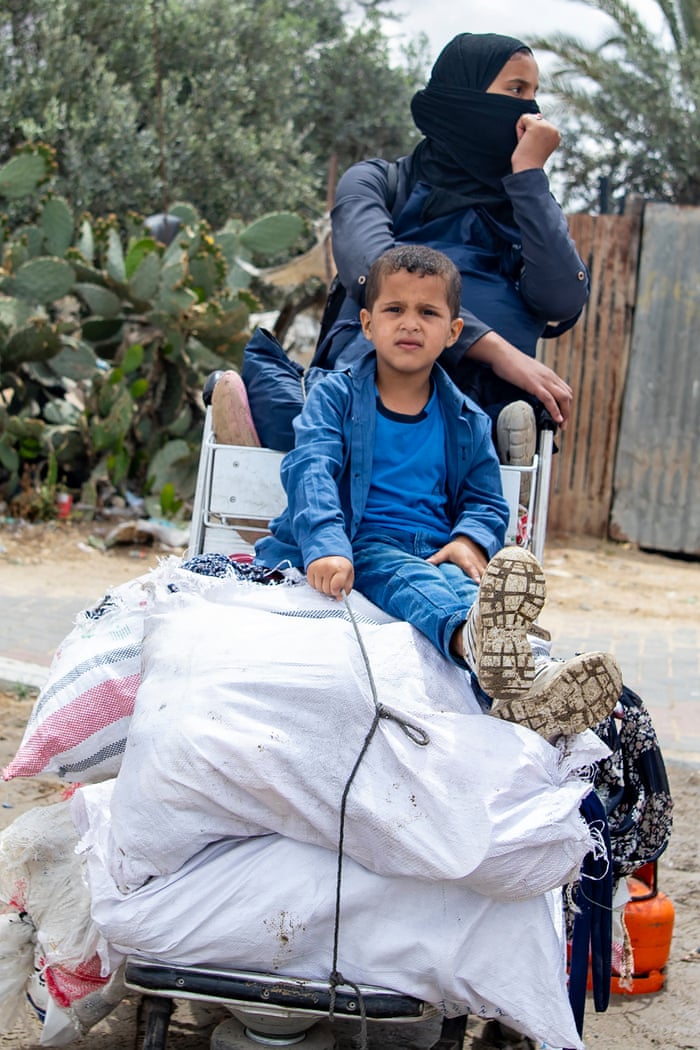
Thousands of people are evacuating from Rafah, Gaza’s southernmost city, hours after the Israeli military told residents and displaced people in eastern neighbourhoods to leave in advance of a long-threatened attack on the city and its environs. Witnesses described frightened families leaving the city on foot, riding donkeys or packed with their belongings into overloaded trucks on Monday. Overnight Israeli airstrikes had reinforced “panic and fear”, prompting more to heed the instructions to move.
The Israel Defense Forces (IDF) said they had dropped leaflets and were broadcasting instructions through “announcements, text messages, phone calls and media broadcasts in Arabic” telling residents to head to what it called an “expanded humanitarian zone” on the coast.
A senior Hamas official described the Israeli order for civilians to evacuate Rafah as a “dangerous escalation that will have consequences”. Hamas also warned that any military operation in Rafah “will not be a picnic”, saying its military wing is “ready to defend our people and defeat the enemy”. Palestinian news agency Wafa has reported that 22 Palestinians, including eight children, have been killed by Israeli strikes on Rafah since yesterday evening.
In a televised address on Sunday, Benjamin Netanyahu, the Israeli prime minister, rejected Hamas’s demands for a definitive end to the war in Gaza, saying that any permanent ceasefire would allow the Islamist organisation to remain in power and pose a continuing threat to Israel. US president Joe Biden and Netanyahu are set to speak by phone today.
Israel closed the Kerem Shalom crossing, one of the main crossings used to deliver humanitarian aid into Gaza, after a rocket attack claimed by Hamas killed four soldiers. The armed wing of Hamas said it fired rockets at an Israeli army base next to the crossing.
Egypt has raised its military’s level of preparedness in northern Sinai, which borders the Gaza Strip.
Philippe Lazzarini, the commissioner-general of the UN agency for Palestinian refugees, Unrwa, has said his organisation will not be evacuating Rafah.
Noga Weiss, who was one of the hostages seized and abducted by Hamas on 7 October, then released in November last year as part of the ceasefire and hostage-release deal, has enlisted today in the IDF.
Germany has criticised Netanyahu’s government for its decision to ban Al Jazeera in Israel, saying it was “the wrong signal”. Israeli officials have claimed the move was justified because Al Jazeera was a threat to national security.
Tents have started springing up today on the lawns of the UK’s oldest universities, Oxford and Germany has criticised Benjamin Netanyahu’s government for its decision to ban Al Jazeera in Israel, as student protesters gather to pressure their institutions to divest funds from Israel as part of a growing worldwide student protest movement.
Tents have started springing up today on the lawns of the UK’s oldest universities, Oxford and Cambridge, as student protesters gather to pressure their institutions to divest funds from Israel.
The protesters have arrived with supplies, sleeping bags and cardboard signs bearing hand-painted slogans that read “there are no universities left in Gaza” and “divest from genocide”. A large banner reads “welcome to the people’s university for Palestine” outside the encampment in front of the Pitt Rivers Museum in Oxford.
The encampments mirror the wave of protests that have swept across universities in the US, which have led to mass arrests of students and staff. They are now quickly spreading across university campuses in what organisers are calling a “global student uprising”, which includes UK universities University College London, Manchester, Newcastle, Sheffield, Leeds, Warwick, Swansea and Bristol.
At Oxford, camp leaders have pinned up a board with a list of six demands to the university, including to “boycott Israeli genocide, apartheid and occupation”, to “disclose all finances”, “stop banking with Barclays”, help rebuild Gaza’s education system and “divest from Israeli genocide, apartheid and occupation”.
A list of demands posted to social media by Cambridge For Palestine organisers urges that the university “discloses and divests from its financial and professional support for Israel’s genocide of Palestinians in Gaza; re-invests in affected academics; and protects all forced migrants and protesting students”.
It also cites the ways in which it claimes the university “facilitates the ethnic cleansing of Palestine”, through academic partnerships and investments in companies which manufacture arms for the Israeli government.
The encampment on King’s Parade, Cambridge is hosting a number of events over the day, including de-escalation training for protesters, a rally and a dinner funded by the Palestinian Solidarity Campaign.
An Oxford University spokesperson said the university was aware of the demonstration, adding: “We respect our students and staff members right to freedom of expression in the form of peaceful protests. We ask everyone who is taking part to do so with respect, courtesy and empathy.”
Foreign minister of the Netherlands, Hanke Bruins Slot on Monday called for an urgent “diplomatic solution” to end intensifying clashes between the Lebanese Hezbollah militant group and the Israeli military along the UN-drawn blue line that seaprates Israel and Lebanon.
“The Netherlands has grave concerns about rising tensions in the border region and intensified fighting, and we regret the loss of innocent civilian lives,” Bruins Slot said after a meeting with her Lebanese counterpart, caretaker foreign minister Abdallah Bou Habib in Beirut. “And this has implications for Lebanon and the wider region.”Unrwa's Lazzarini: Rafah offensive will make it 'even more difficult to reverse expansion of man-made famine' in Gaza
Philippe Lazzarini, the commissioner-general of the UN agency for Palestinian refugees, Unrwa, has added to the organisation’s earlier message that it would not be evacuating Rafah. In a post to social media, he said:An Israeli military offensive will lead to an additional layer of an already unbearable tragedy for the people in Gaza. It will make even more difficult to reverse the expansion of the already man-made famine.
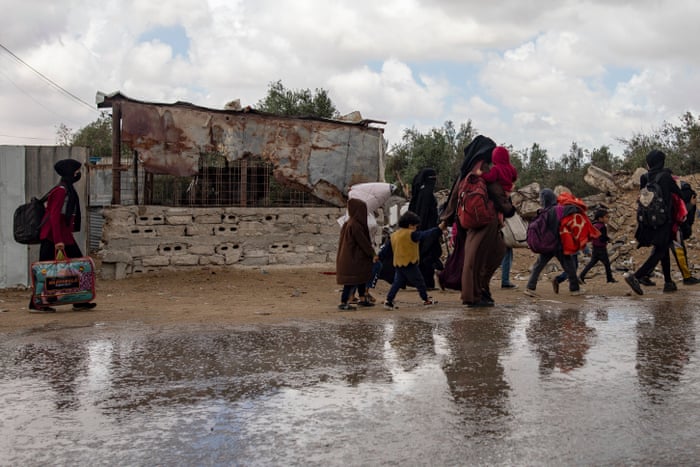
Here are some more images sent to us over the news wires from Rafah in the south of Gaza, showing Palestinians fleeing after Israel ordered an evacuation of the eastern part of the city in advance of an expected military assault.
0 comentários:
Post a Comment